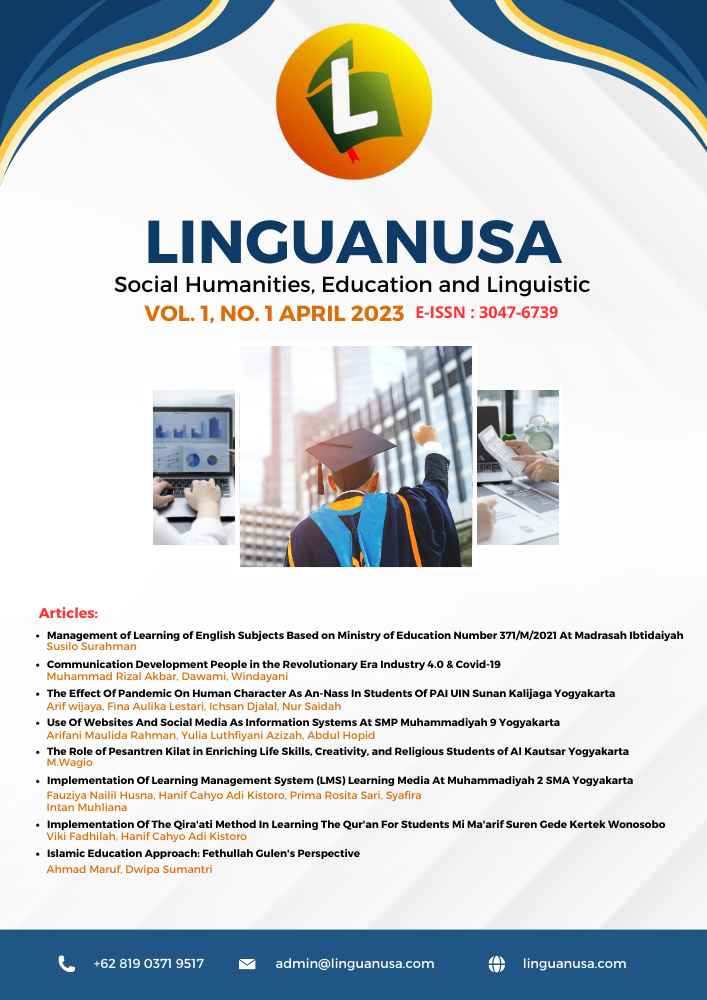
Implementation Of Learning Management System (LMS) Learning Media At Muhammadiyah 2 SMA Yogyakarta

Authors

  • Fauziya Nailil Husna
  • Hanif Cahyo Adi Kistoro Universitas Ahmad Dahlan
  • Prima Rosita Sari Universitas Ahmad Dahlan
  • Syafira Intan Muhliana Universitas Ahmad Dahlan

DOI:

https://doi.org/10.63605/ln.v1i1.37

Keywords:

Implementation, Learning Media, Learning Management System, Supporting Factors, Inhibiting Factors

Abstract

Introduction to The Problem : The occurrence of the COVID-19 pandemic is increasingly rampant, the thing that is being hotly discussed is related to face-to-face learning into virtual face-to-face . That correct occurs in an early learning  conducted by stare advance Becomes virtual stare. Purpose : Based on the SE Minister of Education and Culture an appeal for doing education online and working from the house to avoid the spread of COVID-19. The moment occurs the COVID-19 pandemic; there are changes in implementation One of the media that can be held for online learning is the Learning Management System (LMS) as implemented in SMA Muhammadiyah 2 Yogyakarta. Design/methods/approach : The destination of the study is to know the implementation of the learning media Learning Management System (LMS) at SMA Muhammadiyah 2 Yogyakarta. In addition, for knowing factor support and inhibitor in online learning performance using LMS. Subject from the study this namely five teachers with different eye lessons . Data collection techniques in research this use observation , interview and documentation with instruments that have been compiled . Data validity in the study this use triangulation data source . Data analysis techniques using procedure data reduction , data presentation and data interpretation. Findings : The results of this study find two Things important that is first , the implementation  of the Learning Management System conducted through stages of planning , implementation and evaluation . Finding second is existence factor supporters like existence data plan help , strong signal , and adequate devices. The temporary factor of the barrier is no existence quota , no existence signal , and devices that do not adequate . Research implications/limitations : Studies still have limitations on subjects and data processing. Originality/value : For the next researcher, it is hoped that could dig and research further so that could add more results  deep

Downloads
Download data is not yet available.

References

Ikhwan, M., “Character Education: Concepts and Implementation in Learning in Schools/Madrasahs”, dalam El-Tarbawi, vol. 7, no. 1, 2014, hlm. 61–67.

Arsyad, A., Learning Media, Jakarta, PT Raja Grafindo Persada, 2011.

Dhika, H., Destiawati, F., Surajiyo, S., dan Jaya, M., “Implementation of Learning Management System in Learning Media Using Moodle”, dalam Proceedings of the National Seminar on Information Science Research (Scenarios), vol. 2, no. 0, 2020, hlm. 228–234.

Fitriani, Y., “Analysis of the Utilization of Learning Management Systems (LMS) as Online Learning Media During the Covid-19 Pandemic”, dalam Journal of Information System, Informatics and Computing (JISICOM), vol. 4, no. 2, 2020, hlm. 1–8.

Gusman, B. A., Kistoro, H. C. A., dan Ru’iya, S., “Strategy of Islamic Religious Education Teachers in Cultivating Islamic Character During the Covid-19 Pandemic”, dalam Al-Qalam, vol. 38, no. 2, 2021, hlm. 209–224.

Harahap, P., Adam, M., dan Balisranislam, B., “Implementation of Solar Power Plant Trainer Kit as Electrical Installation Learning Media Development”, dalam Abdi Sabha: Journal of Community Service, vol. 2, no. 2, 2021, hlm. 198–205.

Hopid, A., dan Kistoro, H. C. A., “The Existence of Islamic Education in Pandemic (Case Study on Communities Not Having Online Learning Facilities)”, dalam Fikroh: Journal of Islamic Thought and Education, vol. 15, no. 2, 2022, hlm. 153–170.

Kementerian Pendidikan dan Kebudayaan, “Pedoman Penyelenggaraan Pembelajaran dari Rumah dalam Masa Darurat Penyebaran Covid-19 (Surat Edaran Nomor 15 Tahun 2020)”, 2020.

Kistoro, H. C. A., Zulvia, M., dan Asyha, A. F., “Study of Teacher Competence and Educational Linearity in Improving Student Achievement”, dalam Al-Tadzkiyyah: Journal of Islamic Education, vol. 10, no. 2, 2020, hlm. 245–255.

Masduki, Y., Abu-Hussin, M. F., Kistoro, H. C. A., Parjiman, dan Zainuri, A., “The Impact of the Covid-19 Pandemic on Student Learning Motivation”, dalam Conciencia: Journal of Islamic Education, vol. 21, no. 2, 2021, hlm. 39–51.

Naseh, A. H., Kistoro, H. C. A., Latipah, E., dan Putranta, H., “Implementation of Religious Learning for Students with Special Needs Through Online Applications During the Covid-19 Pandemic”, dalam Journal of Theoretical and Applied Information Technology, vol. 100, no. 3, 2022, hlm. 690–704.

Noor, J., Research Data Analysis, 2015, hlm. 31–40.

Pane, A., dan Dasopang, M. D., “Study and Learning”, dalam Fitrah: Journal of the Study of Islamic Sciences, vol. 3, no. 2, 2017, hlm. 333–352.

Pangaribuan, S. S., Learning Media Design Based on Learning Management System (LMS) with Moodle, Unimed, 2022.

Pertiwi, F. T., dan Sumbawati, M. S., “The Influence of Chamilo-Based Learning Management System and Motivation on Learning Outcomes”, dalam IT-Edu, vol. 3, no. 2, 2018, hlm. 88–97.

Putra, E. A., Sudiana, R., dan Pamungkas, U. S. A., “Development of Smartphone Learning Management System (S-LMS) as Mathematics Learning Media”, dalam Kreano: Journal of Creative-Innovative Mathematics, vol. 11, no. 1, 2020, hlm. 36–45.

Radino, Kistoro, H. C. A., Munajat, N., Putranta, H., Kesuma, A. T., dan Lumaurridlo, “Distance Learning Strategies Using Technology for Elementary School Students in Yogyakarta During the Covid-19 Pandemic”, dalam Journal of Theoretical and Applied Information Technology, vol. 99, no. 9, 2021, hlm. 2031–2039.

Downloads

Published

2023-04-25

How to Cite

Fauziya Nailil Husna, Hanif Cahyo Adi Kistoro, Prima Rosita Sari, & Syafira Intan Muhliana. (2023). Implementation Of Learning Management System (LMS) Learning Media At Muhammadiyah 2 SMA Yogyakarta . Linguanusa : Social Humanities, Education and Linguistic, 1(1), 59–74. https://doi.org/10.63605/ln.v1i1.37